


Built to Last: Why Sydney Schools Are Choosing Premium Wicking Beds
Updated: Jun 6
A garden bed should still be standing — and still producing — long after the students who planted it have graduated. Here is why a growing number of NSW schools are building theirs once and building them properly.

Most school veggie gardens start with the best intentions and end the same way: a few seasons in, the cheap pine sleepers have gone soft and black, the corners have blown out, and the bed that was meant to teach a generation about growing food has quietly become a maintenance problem on the grounds list. Over a holiday or two with nobody to water, the plants give up as well.
It does not have to go that way. At UrbanVeg, we design and build premium timber wicking beds for schools that are made to be a twenty-year fixture, not a two-year experiment — and because they water themselves, they sail through the school holidays without anyone lifting a hose.
Many schools also use council grants and funding programs to pay for their beds including the Stephanie Alexander Kitchen Garden grants.
Built once, built properly
This is where most school beds are won or lost, and it is the part you cannot see once the soil goes in.
The majority of raised beds installed in schools use cheap CCA-treated pine — the green-tinged timber from the hardware store. It is inexpensive for a reason: in constant contact with wet soil it breaks down within a few years, and CCA pine is treated with copper, chromium and arsenic, which is not what most schools want surrounding the vegetables their students will eat. Steel beds are the other common choice, and they rust, dent and heat up in the Australian sun.

We build with kiln-dried, iron-oxide-preserved, vegetable-grade timber — the same premium material we put into our own beds. It is food-safe, it stands up to knocks and kicks far better than thin steel, and it is fully lined so the timber never sits against wet soil. The result is a bed that looks the part on day one and is still doing its job a decade later. When a school invests in a garden, that longevity is the difference between a one-off cost and a recurring one.
Self Maintaining — Including Over School Holidays
Every UrbanVeg bed is a self-watering wicking bed. There is a water reservoir built into the base, and the plants draw moisture up from below through the soil exactly as they need it. That one design choice solves the problems that quietly kill school gardens:
No watering over the breaks. Fill the reservoir before the last day of term and the beds keep the plants supplied right through the holidays. For longer breaks or a heatwave, a groundskeeper topping up with a hose for ten minutes every few weeks is all it takes.
Far less weeding. Because the beds water from below, the surface stays dry and weed seeds get almost no chance to take hold — so the garden is not a constant job for staff or students.
Bigger harvests. A steady supply of water and nutrients means consistently higher yields, which is what keeps students excited and keeps the program alive year after year.
If you would like the full rundown on how wicking beds suit a classroom setting, we cover it in 5 Reasons Wicking Beds Are Great for Schools.
Proven at scale, across NSW
UrbanVeg has grown from backyard beds into one of the larger institutional installers in the state, and schools are now the heart of what we do. A few recent examples:

Pennant Hills High School
One of our largest school installations to date: 22 premium wicking beds, prefabricated and installed to give the school a serious, lasting growing space.

Gunnedah South School
16 new beds placed around a previous install of 6 comprised this regional install showing we travel well beyond Sydney for the larger multi-bed jobs. See the Gunnedah South project.
Hurlstone Agricultural College
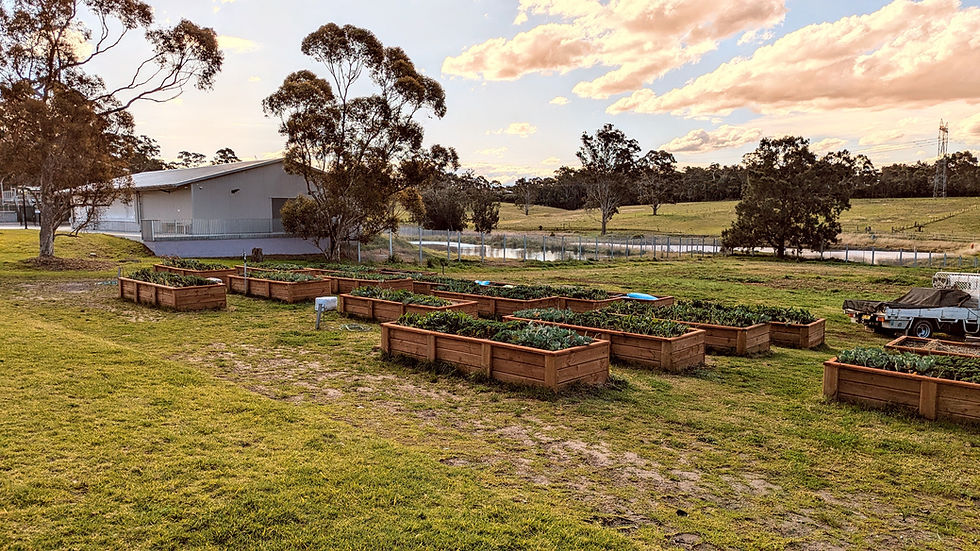
A NSW Government project to update the on-site farm, with 18 large beds initially giving 82 square metres of sub-irrigated growing area for hands-on agricultural education. The project was later extended with an additional 6 beds bringing the total to 24.

Newington College
A 6 bed rooftop installation in Stanmore demonstrates that a productive garden does not need ground space, just good design. These beds can sit on hard surfaces such as rooftops and playgrounds. See the Newington project.
There are many more examples, including Hampden Park Public School, Gladesville Public School, Plumpton Public School and Mount Terry Public School. You can browse the full project gallery here.
Designed around students
Our school beds are typically built to 650 mm high — a comfortable working height for children to plant and harvest without bending, tall enough to discourage anyone walking on them, and close enough to eye level to spot pests early. The beds can also be fitted with a built-in worm composter, so offcuts go straight back in and students get to see a closed nutrient loop in action. It is a real, working lesson in sustainable food production, not just a planter box.
Easy to bring into a school

We handle the whole project — design, prefabrication, delivery and installation — with as little disruption to the grounds as possible. We are set up for school and government procurement, hold a NSW Department of Education vendor number, and our Public Liability insurance, Working with Children Check and White Card are all current. In short, we are straightforward to engage and we leave a finished, ready-to-plant garden behind.
Book a site visit
If your school is thinking about a garden — whether it is two beds for a kindergarten or twenty for a senior campus — the best place to start is a no-obligation site visit. We will look at the space, talk through what will work, and put together a clear quote.
Call Dom on 0433 971751 • email info@urbanveg.com.au • or visit urbanveg.com.au/wicking-beds-for-schools
Plant, Pick, Share.


